The logs say everything is fine
Your dashboards show green lights across the board. Operational metrics update continuously. Alerts are ready to fire and a thresholding system captures thousands of events per minute.
Then someone asks a simple question. Where exactly did that inference run last Tuesday? Who had access to the training data during that specific window? What happened to the personal information after deletion?
The answer should take minutes. Instead, it takes days. Multiple teams get involved. Someone checks the documentation. Someone else contacts the cloud provider. You piece together fragments from different systems until the best answer you can give is “probably” or “we think” or “based on what we can see.”
Monitoring is not transparency
Most organizations assume extensive logging means transparency. They capture metrics, collect events, track performance. The infrastructure looks visible.
But monitoring and transparency solve different problems. Monitoring tells you that something happened. Transparency tells you where it happened, under which conditions, and who could have influenced it.
Monitoring fills dashboards. Transparency answers questions.
Logs capture activity without necessarily capturing context. You see that data moved, but not which servers it touched. You see API calls, but not who made them or under which permissions. You can watch your AI systems closely while knowing very little about how they actually operate.
The questions logging can’t answer
The black box becomes visible when someone asks for proof instead of patterns. It happens during audits, compliance reviews, security investigations, internal governance checks.
Standard logging struggles to answer these questions:
- Compliance asks where an inference ran geographically. Your logs show cluster ID, not the jurisdiction or physical location you need to verify.
- Auditors want to know who accessed training data last week. Logs show API calls, not the actual people or their full permission chains.
- Legal needs to verify EU data stayed in EU. Logs show regions, but not the complete path data took or where temporary copies landed.
- Security asks what happened to deleted data. Logs show deletion events, but reconstructing what happened across all storage layers takes days.
- Finance wants workload costs traced back to specific projects. Billing shows GPU hours consumed, not which teams or datasets drove them.
- Internal reviews ask how a model made a specific decision. Logs capture inputs and outputs, but connecting them to model versions and training lineage requires investigation.
Every question seems reasonable. Every answer should be simple. The infrastructure was built to run workloads efficiently. Nobody designed it to answer interrogation. That mismatch costs money when transparency becomes mandatory.
The architecture that creates black boxes
Cloud providers build for scale and efficiency. Making individual customer workloads fully transparent runs secondary to keeping the platform operational. This determines what you can see and what remains hidden.
Multi-tenancy means your workloads share hardware with hundreds of other customers. Your logs show your jobs. They cannot show what else ran on the same servers, how resources split under pressure, or why performance dropped on Wednesday. The platform hides these details by design.
Data paths appear simplified in logging. You see region names and zone identifiers. Physical servers, network hops, temporary storage locations during processing. None of that surfaces. Access control runs through multiple systems. Reconstructing who could reach specific data at a specific moment requires investigation across platforms you cannot fully inspect.
Regulators now expect verifiable answers. The AI Act and similar frameworks demand proof, not estimates. Auditors bring checklists where they used to bring guidelines. Boards ask questions they ignored two years ago. “We believe it stayed in Europe” no longer closes the conversation. “The logs suggest this pattern” does not satisfy compliance officers.
The cost appears in blocked projects. Legal teams hold AI rollouts until someone answers the transparency questions. Compliance reviews that should take weeks stretch into months. External auditors bill premium rates to reconstruct what internal logs cannot reveal. Some organizations discover during acquisition due diligence that they cannot verify their own claims about AI operations.
What changes with a sovereign stack
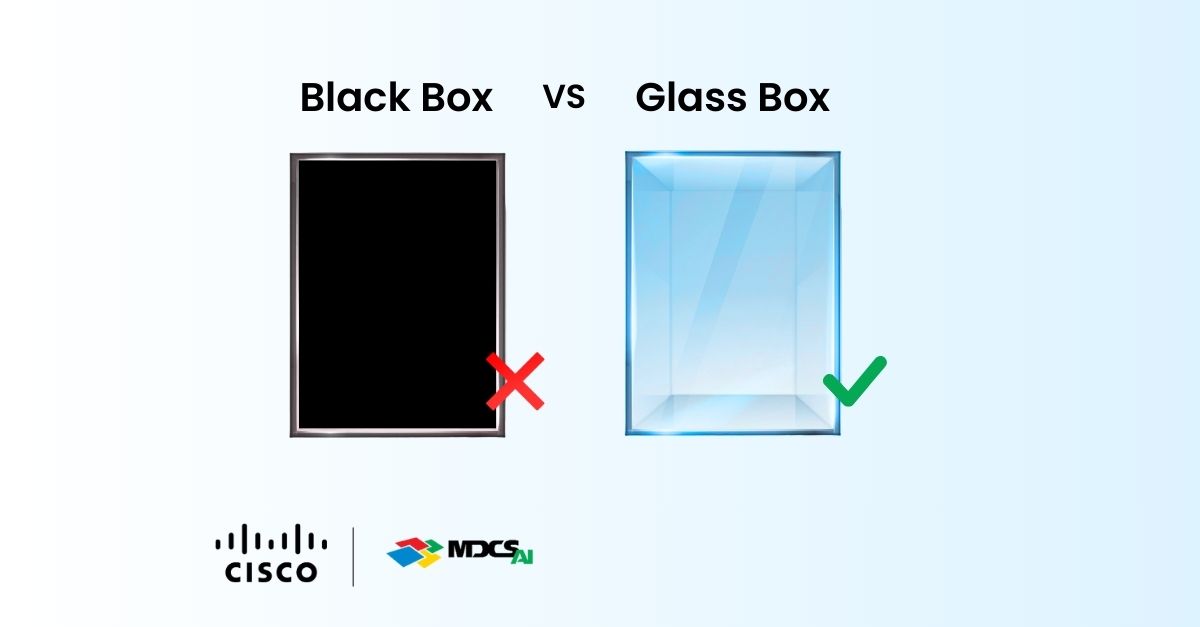
A glass box means different architecture, beyond better logging. Owning the full stack, hardware through software layers, makes transparency structural instead of something you request.
The difference appears in which questions you can answer and how fast you get answers.
| Question | Black Box (Cloud) | Glass Box (Sovereign) |
|---|---|---|
| Where did this run physically? | Cluster ID, region metadata | Direct visibility into servers, racks, and datacenter infrastructure |
| Who accessed this data? | API call logs, filtered by provider | Access to complete audit trails without requesting from third parties |
| What happened to deleted data? | Deletion events in logs | Ability to verify and trace data lifecycle across owned infrastructure |
Cloud providers operate reliable infrastructure. The question is whether you need architectural transparency they were not designed to provide. When AI becomes strategic, transparency needs to be a property you control, not a feature someone grants you access to.
“In a cloud environment, transparency is something you ask for. In a sovereign stack, it is something you have. Every layer is auditable because every layer is yours to audit. There is no black box because there is no layer that belongs to someone else.”
– Niels Van Rees, MDCS.AI
Questions that took days to investigate get resolved in hours. Audits become less disruptive because the information sits in systems you control. Compliance documentation becomes simpler when you can inspect the infrastructure directly.
Can your infrastructure answer these?
Here is a quick test. For each question, ask whether you can answer it right now with certainty, or whether it requires investigation and still ends with “probably.”
Can you answer these with certainty?
- Where exactly (physical location, jurisdiction) did your last production inference run?
- Who had access to your training data last week (actual people, not just API keys)?
- What happened to deleted personal data across all your storage layers?
- Which specific model version was used for a particular decision three weeks ago?
- Can you provide a complete audit trail without asking your infrastructure provider for help?
If you answered “no” or “not sure” to more than two questions, the infrastructure cannot provide the transparency you need. This reflects architectural limits, not process failures.
What real transparency requires
Transparency means infrastructure where you can inspect every layer, trace every decision, and verify every movement. Better dashboards and more detailed logs help. They do not change the underlying architecture.
This level of visibility requires owning the infrastructure, including the workloads and the stack underneath them. Organizations building strategic AI face a choice. The architecture that worked for experimentation may not support production AI at scale. Monitoring shows you patterns. Transparency lets you answer questions.
Sovereign infrastructure gives you direct answers to questions about your AI operations. You do not depend on external parties to open their systems first. That independence matters more as AI becomes central to how your organization operates.
Want to explore what complete transparency looks like for your AI infrastructure? Get in touch with our team or register for our AI insights below.
| Niels van Rees | MDCS.AI Co-Founder & Chief Operations |